

Your wedding day is very special, your chance to wear something as romantic or as outrageous as you want. You want to look your best and what better way than to give yourself the wasp waist you have always dreamt of.
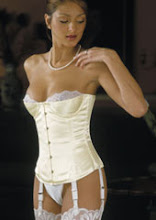
A corset accentuates your bust and hips and is particularly appropriate under a traditional wedding dress with a fitted bodice. Corsets can also be worn over a dress as a bodice or waist cincher, for the Snow White look.
If you want something out of the ordinary, a corset can be worn on its own with a skirt or even trousers for a stunning and unconventional look, and the back lacing will give the congregation and/or guests something to look at besides the back of head during the ceremony.
Planning Your Outfit
You need to choose your style well in advance, making sure that it works with your whole outfit. Before ordering a corset, get accurate measurements for your bust, waist and hips (your dressmaker, if you are using one, will help you, otherwise ask a friend). A corset will pull your waist in, but be realistic about how tightly you want to be pulled in all day and try it first.
Bear in mind your outline; it is probably best if you are wearing a corset underneath to go for a simple, undecorated style. If you fancy an Edwardian lacy boudoir number like either save it for the wedding night, or even better, buy two! (One for the wedding and one for afterwards).
If you have a bust larger than D cup, you should look at wearing a bra with an under bust style .
Make sure you try everything on together. Check the neckline and back of your outfit you don’t want underwear showing. Will you be wearing stockings or tights? If stockings, you’ll need suspenders (garters) to hold them up, and to decide how many check if the corset comes with suspenders and if you want more added.
http://www.labellelingerie.co.uk/
If you want something out of the ordinary, a corset can be worn on its own with a skirt or even trousers for a stunning and unconventional look, and the back lacing will give the congregation and/or guests something to look at besides the back of head during the ceremony.
Planning Your Outfit
You need to choose your style well in advance, making sure that it works with your whole outfit. Before ordering a corset, get accurate measurements for your bust, waist and hips (your dressmaker, if you are using one, will help you, otherwise ask a friend). A corset will pull your waist in, but be realistic about how tightly you want to be pulled in all day and try it first.
Bear in mind your outline; it is probably best if you are wearing a corset underneath to go for a simple, undecorated style. If you fancy an Edwardian lacy boudoir number like either save it for the wedding night, or even better, buy two! (One for the wedding and one for afterwards).
If you have a bust larger than D cup, you should look at wearing a bra with an under bust style .
Make sure you try everything on together. Check the neckline and back of your outfit you don’t want underwear showing. Will you be wearing stockings or tights? If stockings, you’ll need suspenders (garters) to hold them up, and to decide how many check if the corset comes with suspenders and if you want more added.
http://www.labellelingerie.co.uk/




 Lingerie


 Blinklist.com